
Our reason for going to Prague had nothing to do with tourism. The first in-person meeting of the WG3 working group of the Affect-EVO COST Action was held in Prague 6, at the Technology Centre Prague. So we didn’t experience the city the way a typical traveller does: we went to a meeting in the morning and gave the afternoons and evenings to the city. Perhaps that is why, by the end of the week, we had noticed a pattern: among the places everyone insists you must see, some disappointed us, while many of the places we stumbled upon by chance, or that nobody talks about much, impressed us deeply.
We landed at midday on 11 May. A Bolt took us from the airport to pick up the keys, and a second Bolt took us to the flat; by mid-afternoon we were settled in, online, coffee made. The flat was in Malá Strana, right at the foot of the Wallenstein Garden. That single fact shaped how we moved through the city: out through the garden every morning, back the same way every evening.
The Meeting Days
12 and 13 May went to the first in-person meeting of Affect-EVO WG3. The first day covered the validity framework, presentations from other EU networks and subgroup discussions in the afternoon; the second day closed with subgroup reports and the identification of next steps, and the meeting ended in the early afternoon.
On the evening of the first day there was a dinner in historic Prague. We ate at Dvorek pod Hradem: slow service, but the food was good.
Wallenstein Garden and Malá Strana
The Wallenstein Garden is a park with free entry. Peacocks roam it, and I got plenty of chances to take photos and video. It wasn’t in our plans at all; our flat just happened to be next to it, and that is how we discovered it. It is genuinely a lovely place to sit and spend time. One evening there was a concert in front of the Senate building; we arrived just as it was ending and only caught the last few minutes.
Inside the garden stands the Dripstone Wall, an artificial cave wall covered in stalactite-like formations. We saw it because it was right next to our flat; it is a pleasant structure, but not that interesting on its own.
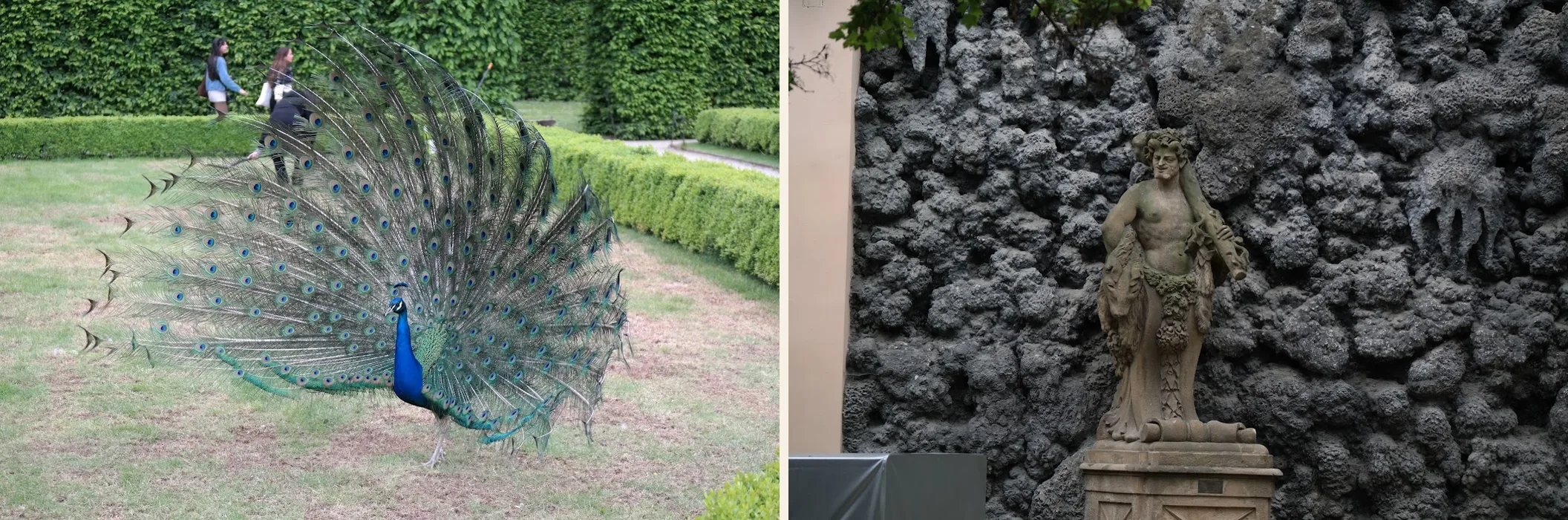 The Wallenstein Garden: a peacock and the Dripstone Wall
Charles Bridge
Construction of the Charles Bridge began in 1357; it is famous for its thirty Baroque statues and gives you a very good view of both banks. My favourite detail about the bridge, though, is a number. The traditional time given for the laying of the foundation stone is 9 July 1357 at 5:31 a.m.; written in year, day, month, hour and minute order, it produces 135797531, a palindrome that reads the same backwards. The story goes that Charles IV’s astrologer deliberately chose this sequence, all its digits odd, as an auspicious sign, but it may well be a legend: neither the exact hour nor the intent is confirmed by any record.
The bridge itself doesn’t quite live up to the magic the story promises. There are beggars on it, and it is crowded almost all the time, especially at sunset. My advice: go at dawn or late at night to avoid the crowds.
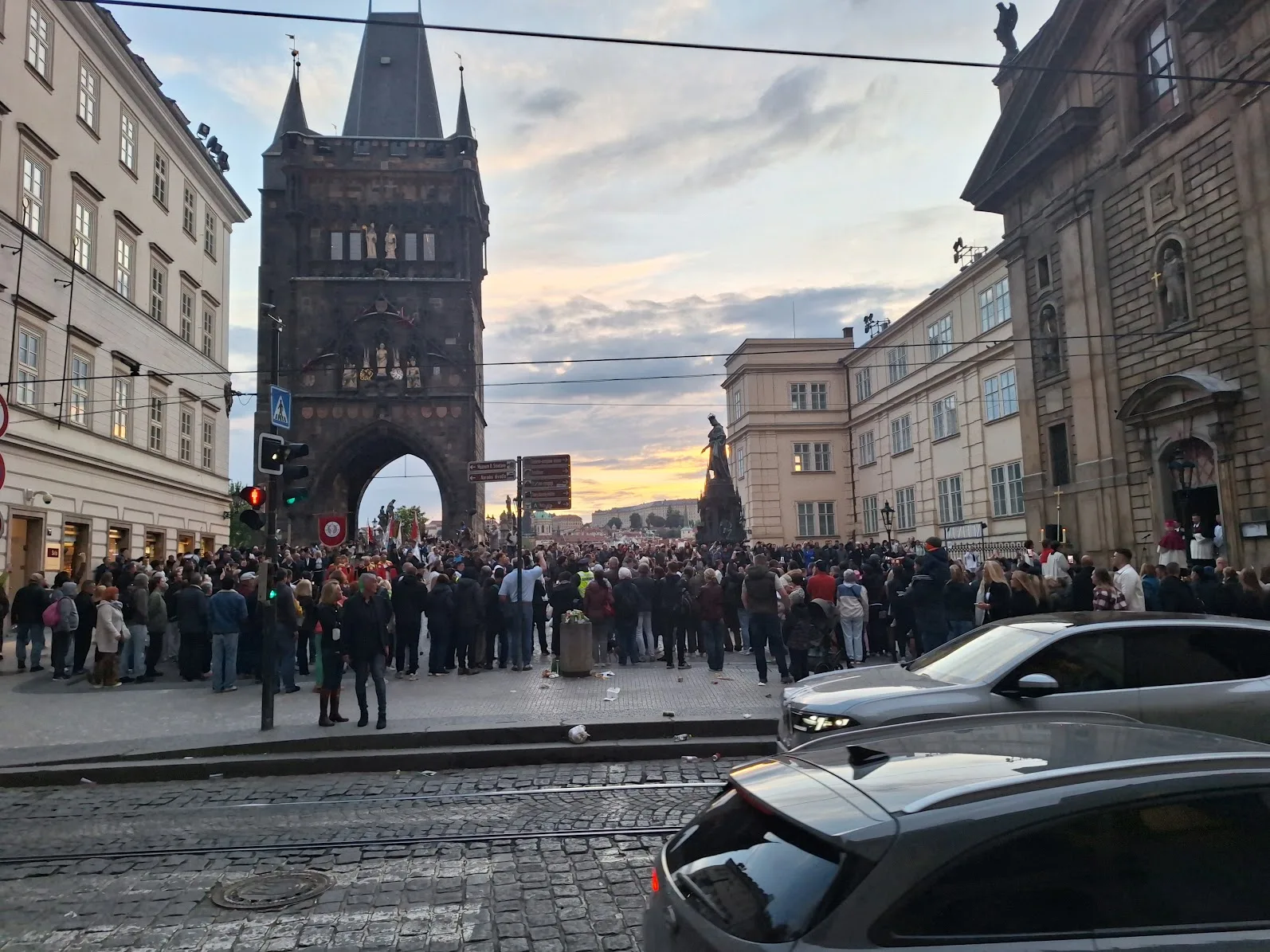 Charles Bridge at sunset
Old Town Square and the Astronomical Clock
Expectations run high for the Old Town Square and its Astronomical Clock, and the reality doesn’t match them. The clock is billed as the oldest astronomical clock still in operation, running since 1410, and the apostles process past on the hour. But there is no magnificent show, and the clock tower falls short too. Even though we went during a quiet time of year, the square was extremely crowded.
Prague Castle: The 450-Crown Ticket
On 14 May we walked the castle’s basic circuit. Prague Castle is both the official residence of the Czech president and the home of the Bohemian Crown Jewels. The visit runs on a single ticket (450 CZK) covering four sites: St. Vitus Cathedral, the Old Royal Palace, St. George’s Basilica and Golden Lane. We visited them in that order.
St. Vitus Cathedral was our first stop and the most magnificent building we saw. The interior is deeply impressive: the Royal Crypt, where the Bohemian kings are buried, and the St. Wenceslas Chapel are both inside. The stained-glass window designed by Alphonse Mucha was made in 1931; because Slavia Bank paid for it, the bank’s name is written beneath the window. They literally sold advertising space on a cathedral window.
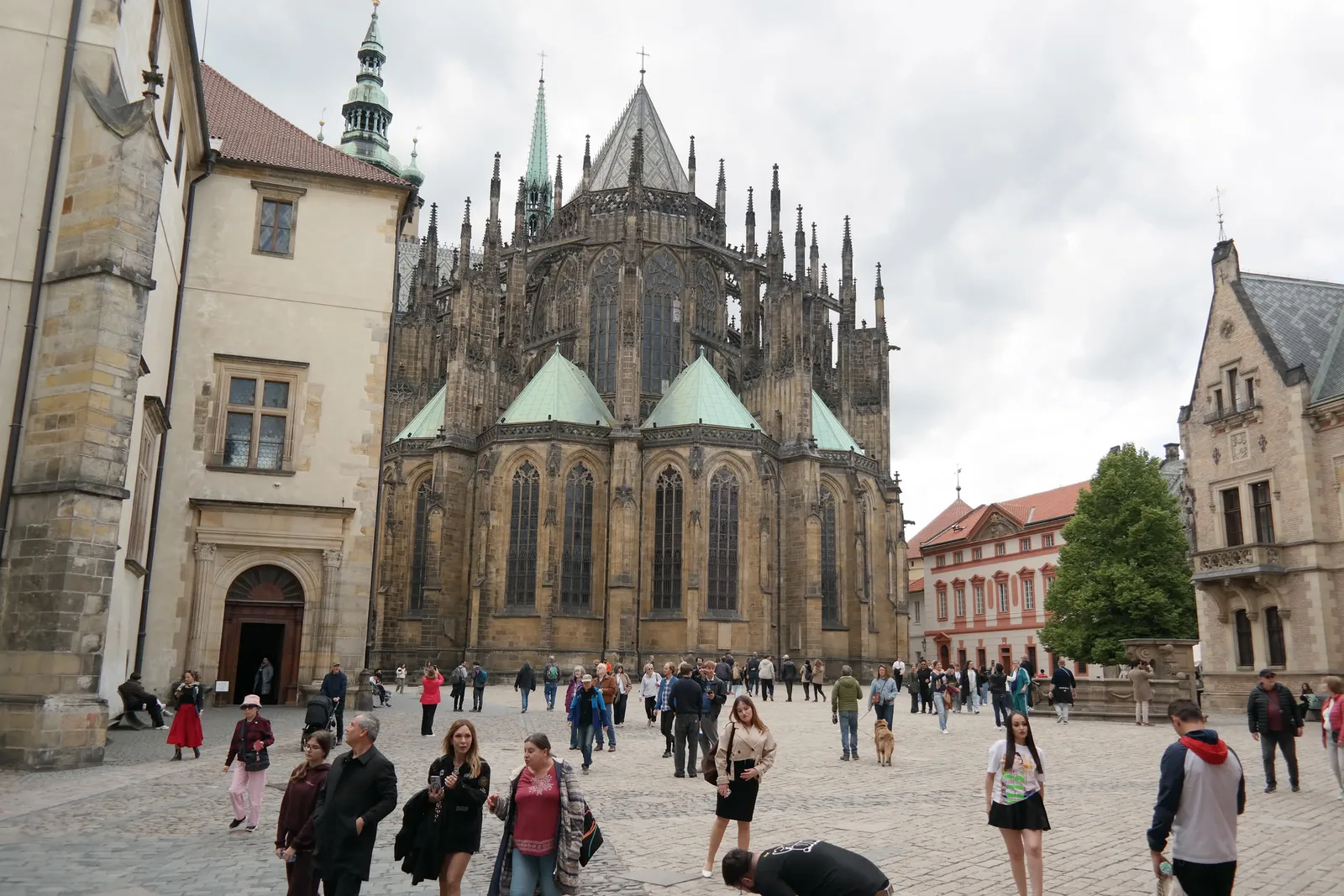 St. Vitus Cathedral
The Old Royal Palace was our second stop. We saw the window where the defenestration took place, along with the palace’s other rooms. The window is in the Ludwig Wing; the Vladislav Hall, with its vast vaulted ceiling, is considered a masterpiece of medieval civil architecture and once hosted indoor jousting tournaments. In 1618 Protestant nobles threw the emperor’s governors out of that window, the spark that lit the Thirty Years’ War. The fact that the governors survived the fall is what turned the event into legend. Its historical weight made it a fascinating place for us.
St. George’s Basilica was our third stop. It is one of the oldest buildings in the castle, going back to AD 920, counted among the earliest examples of Romanesque architecture and known for its acoustics. It looks colourful from the outside but is plainer inside, which is put down to its being built in one era and restored much later in another. A pleasant place, but we wouldn’t have gone if it weren’t included in the ticket.
Golden Lane was our last stop and, to my mind, the best part of the 450-crown ticket. The souvenir shops spoil the atmosphere somewhat, but there are still genuinely lovely corners. You file through the tiny houses one by one. Upstairs are the defensive structures and remarkably well-preserved weapons and armour from the fifteenth and sixteenth centuries; below, the miniature houses themselves. Kafka, too, wrote here for a time, in house number 22. There was also a fortune-teller’s house.
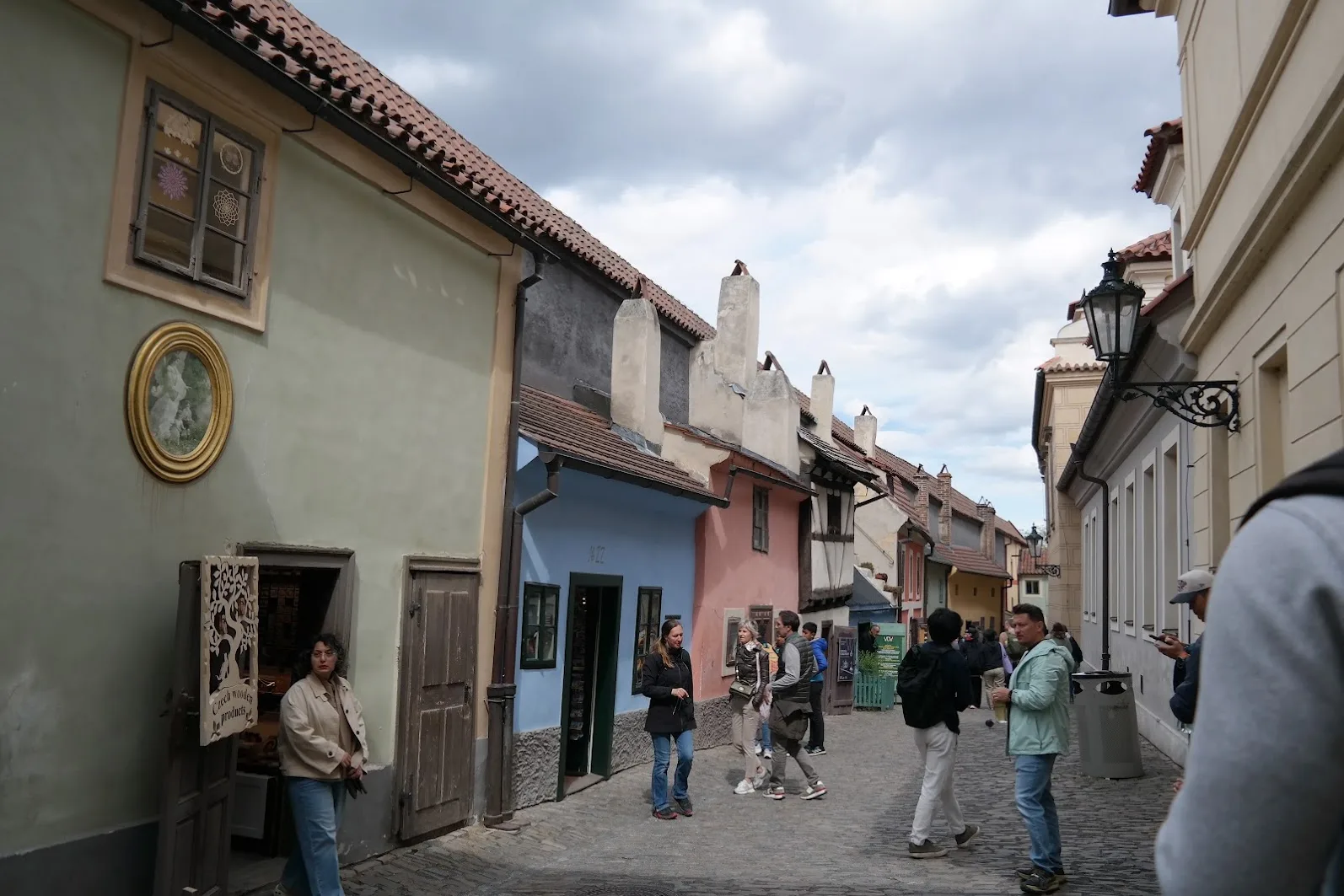 Golden Lane; the blue house is No. 22, where Kafka wrote
Museums
The historic building of the National Museum was the one place that broke the rule: recommended by everyone, and truly worth it, it impressed us more than anything else in Prague. This Neo-Renaissance building crowning Wenceslas Square is a symbol of the Czech National Revival, and we gave it an entire day. We spent seven hours inside, and even then I don’t think we saw it in enough detail; the museum is simply too large for one day. I especially loved the books on display. I plan to dig deeper later, through the photographs we took. Entry is a single ticket of around 350-400 CZK, and it covers only the National Museum’s two buildings: the historic building and the new one. Some online sources say the ticket also covers other museums belonging to the National Museum; ours didn’t, and we couldn’t find a ticket that covered them all. The Czech Museum of Music, which I come to further down, needed a ticket of its own.
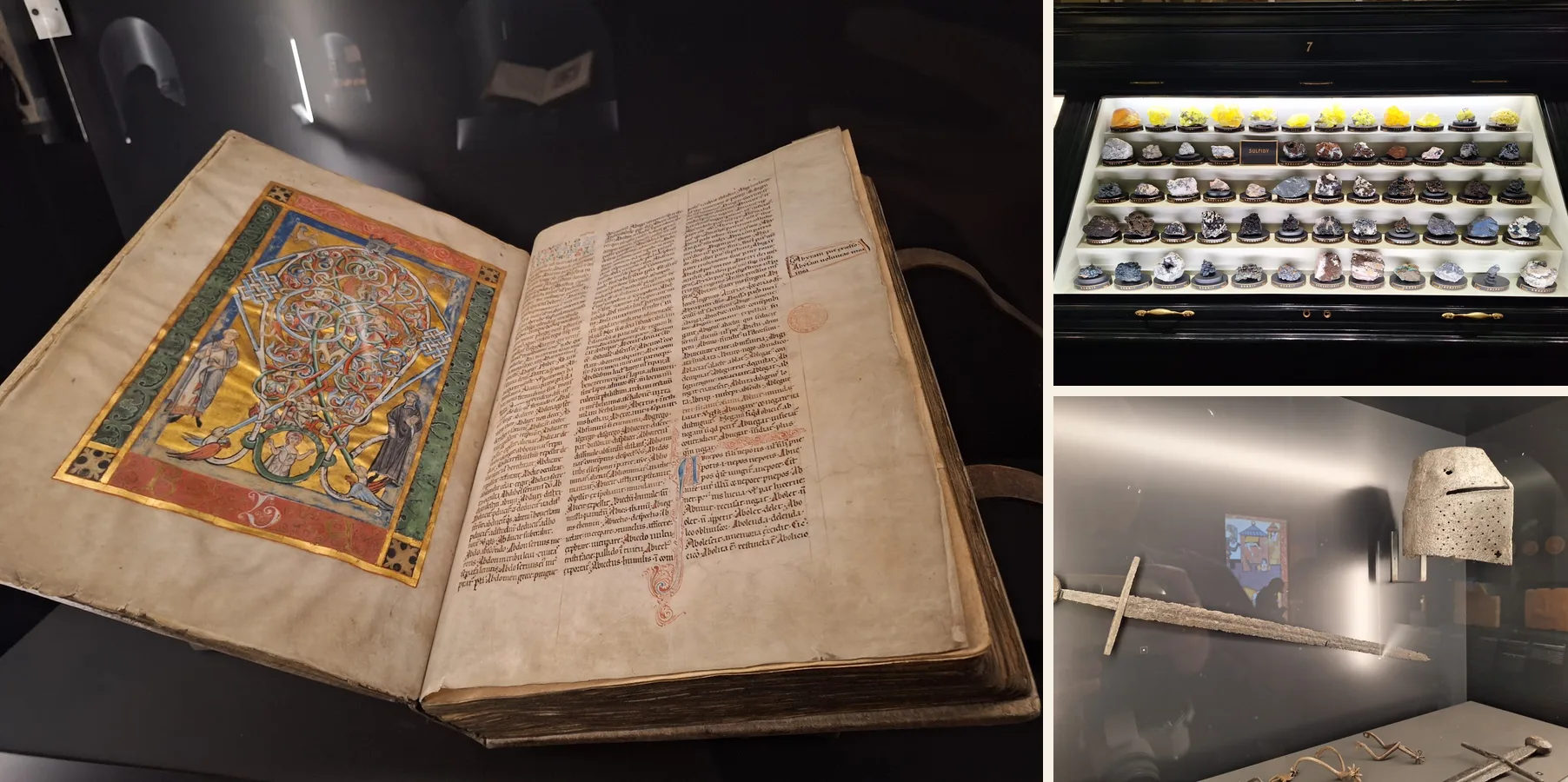 The National Museum: a medieval manuscript, the mineral collection, a knight’s helmet and sword
The new building should be treated as a continuation of the main museum. It was built in 1937 as the Prague Stock Exchange, took its current form with the brutalist-modernist extension added for the Federal Assembly in 1968-1973, and served as the headquarters of Radio Free Europe from 1995 to 2009. Since 2019 it has been linked to the historic building by an underground tunnel. The twentieth century is exhibited here, and the same ticket covers it.
The Ethnographic Museum costs 100 CZK and was a typical ethnographic museum in content, but we especially enjoyed the sections with masks.
The Czech Museum of Music is housed in a former Baroque church. It displays nearly four hundred instruments, some of which visitors can play themselves, and the collection includes a historic piano Mozart played. It isn’t a large museum, but it is a very pleasant one.
Walks and Memorials
The Rotating Head of Franz Kafka isn’t near where we stayed; it stands in Nové Město, near Národní třída, in front of a shopping centre (Quadrio). Now one of the city’s symbols, David Černý’s kinetic sculpture is made of 42 rotating stainless-steel layers. The mechanism’s silent operation struck me as interesting, but there is no technical information around it and no explanation of how it works. The sign only says it runs once an hour, and even that is wrong: it runs every half hour.
We didn’t climb the Petřín Tower; honestly, it didn’t appeal to us. The tower is a 63.5-metre, Eiffel-like steel structure built for the 1891 Jubilee Exhibition and is said to offer Prague’s broadest panorama. But the hill it stands on and the park around it are beautiful. Think of it as a place to walk around rather than a tower to climb.
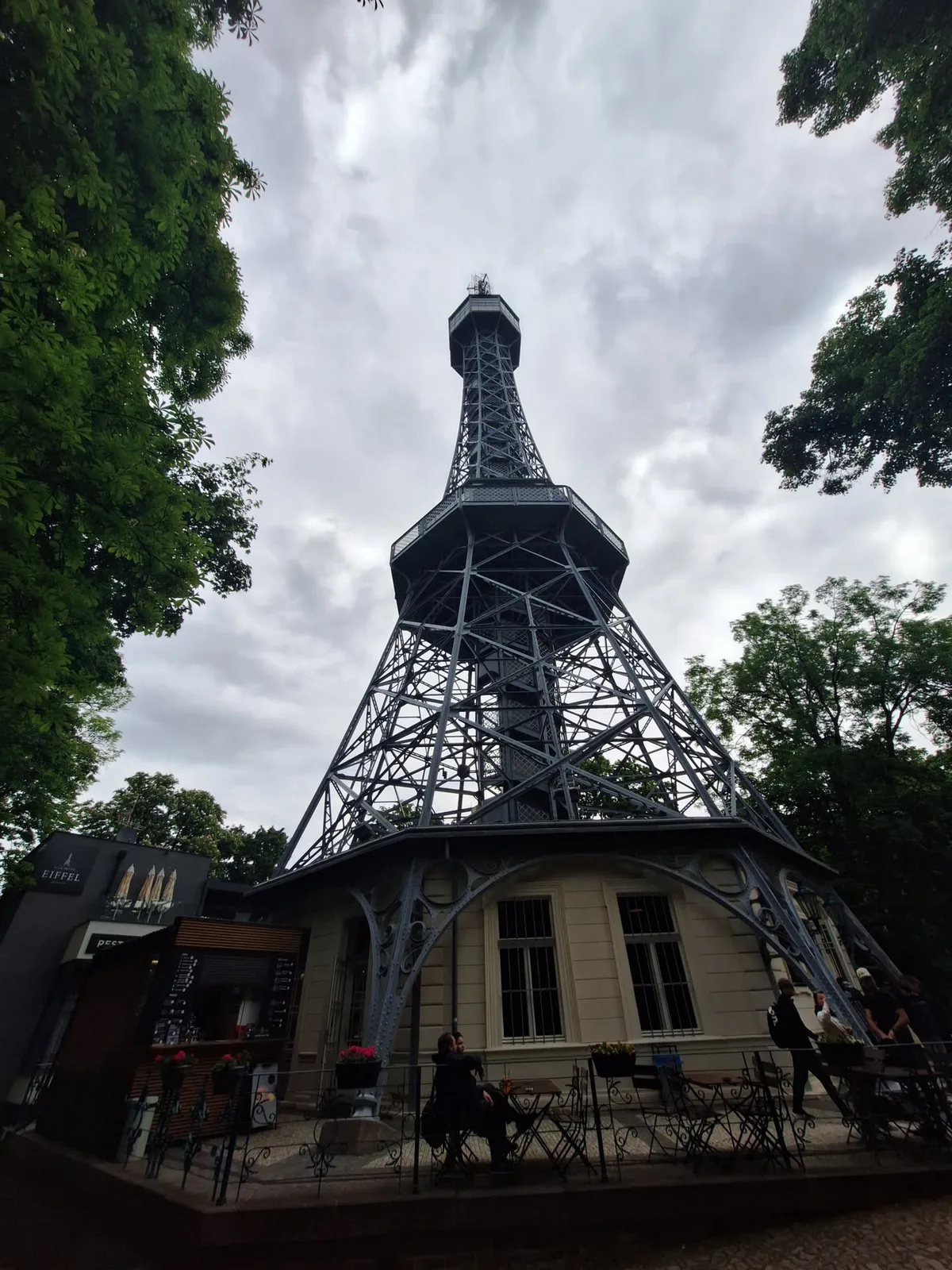 Petřín Tower
Entry to the National Memorial to the Heroes of the Heydrich Terror is free, but we missed the opening hours and couldn’t see the interior. The memorial is the crypt of the Church of St. Cyril and St. Methodius, where the Operation Anthropoid paratroopers hid after assassinating Heydrich. We did see the bullet marks from outside. Prague came through the Second World War without major damage to its infrastructure, yet the marks on this wall still carry the wounds of that time. It is a heartbreaking place, and a reminder of how much it matters to protect a national identity and not surrender.
Rosé May Wine and Food Festival
On 16 May we stopped by the Rosé May (Růžový máj) Wine and Food Festival on the Náplavka embankment: more than thirty wine producers, Mediterranean street food and live music.
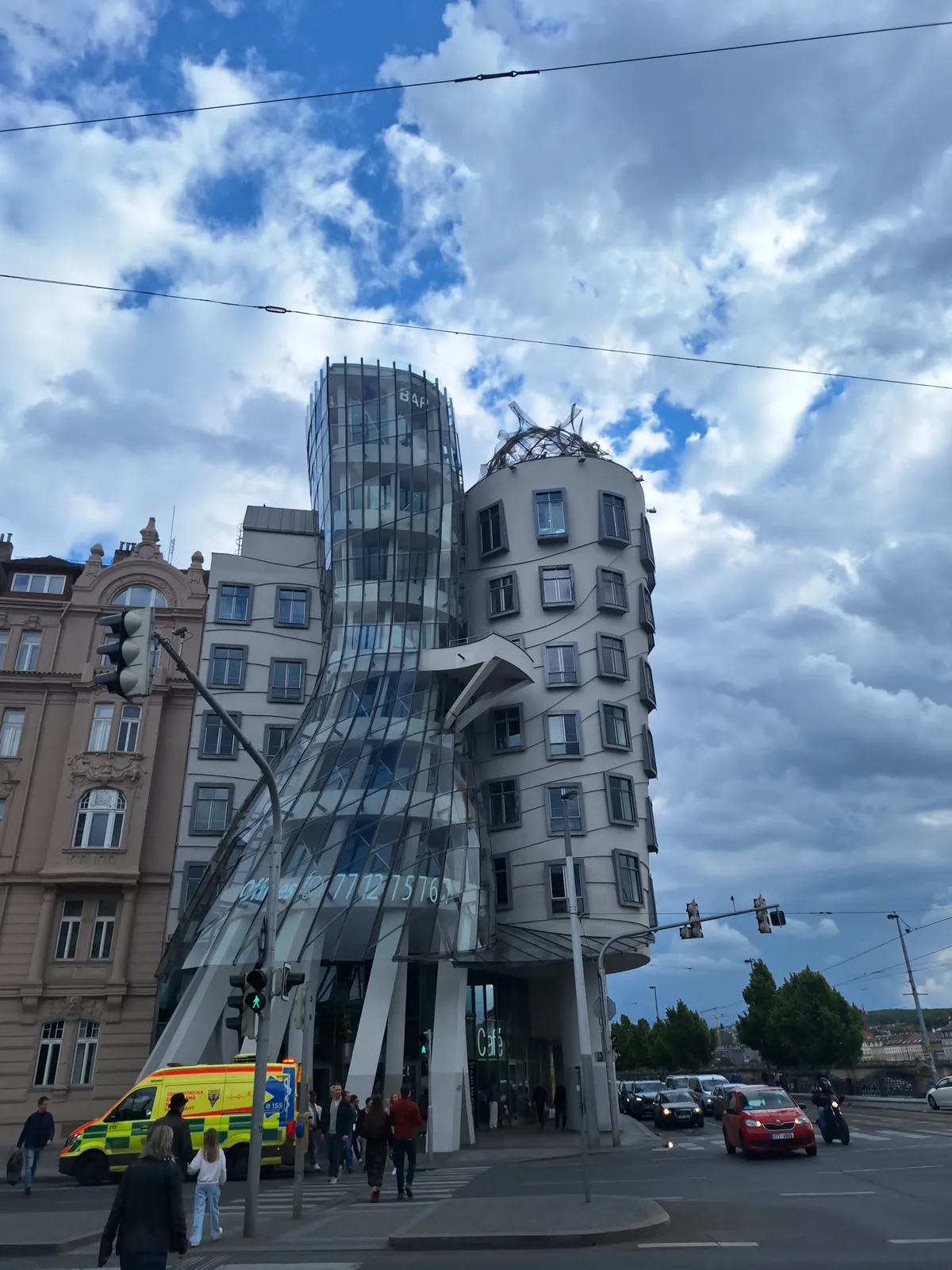 On the way to the Rosé May festival grounds, we also walked past the famous Dancing House.
All week, Prague showed us a kind of fine, intermittent rain we had never known. Almost every day it would start, last ten to fifteen minutes and stop. It came back again and again over the day, stopping just as quickly, and the wetness it left dried off right away. Because the drops were so fine and the showers so short, they barely soaked us. The festival is where we noticed just how little it actually wet us: we wiped the water off the benches and sat down, didn’t look for shelter even when it started raining, and by the end of the day we still hadn’t got properly wet.
Food
Lokál is the ideal place for traditional Czech food and fresh tank beer; we had svíčková. The food was good, but the drink options were limited: no IPA, which the man seated at our table had already been told when he asked. The queueing system is unclear and the waiters are overwhelmed, so nobody can really help you.
We got an unusual seating arrangement: they put two more people at our six-person table, leaving an empty seat between us. The man next to us was from the UK and his wife was American; they had come over from the States. When he pulled out his wallet, it was almost identical to mine; the only difference was the AirTag on his. As we talked, the story somehow found its way to Istanbul: his wife’s childhood friend’s mother was a Turkish singer, and that friend’s daughter had moved to Istanbul without a word of Turkish and had been living there for three years. It was lovely to hear a story that led all the way to Istanbul, at a beer-hall table in Prague.
Going Home
On the way to the airport on 18 May, looking back, the places at the top of every list were the ones that had faded most: the crowd in front of the Astronomical Clock, the crush on the bridge. What stayed were the unplanned things: a garden that happened to be at our doorstep, and its peacocks; a fine rain that never quite managed to soak us; a story at a beer-hall table that led back to Istanbul. The only exception to the rule was the National Museum, where even seven hours weren’t enough. If we go back to Prague, I would rather follow whatever turns up in our path than a guidebook’s list.
Practical Notes
- Dates: 11–18 May 2026.
- Free: the Wallenstein Garden and Dripstone Wall (open April to October), Charles Bridge, watching the Astronomical Clock, the castle gardens, the Heydrich Memorial.
- Prague Castle ticket: full 450 CZK (about €18-19), reduced 300 CZK (ages 6-16, students, 65+), family 950 CZK (two adults plus up to five children), free under 6.
- Other prices: Old Town Hall tower around 300 CZK; National Museum (both buildings) around 350-400 CZK; Ethnographic Museum 100 CZK; Czech Museum of Music around 120 CZK; Petřín Tower around 220 CZK.
- Mornings are better if you want the Wallenstein Garden without crowds.
- Trams 22 and 23 make a cheap scenic tour past the city’s main sights; buy all public transport tickets through the PID Lítačka app.
- Ask for a větrník (windmill pastry with caramel cream) at a local cukrárna.
- Prague introduces itself as “the only city in the world with Cubist architecture”. That is an exaggeration (there are Cubist buildings in other Czech towns too), but there is hardly anywhere else where Cubism was applied to architecture on this scale. The best-known example is the House of the Black Madonna.
Next Time
We collected a list of what we didn’t get to. To see: Vyšehrad Fortress, the Museum of Communism, the Prague Metronome in Letná Park, the Memorial to the Victims of Communism at the foot of Petřín, and the National Technical Museum. Also on the list: the back lanes of Nový Svět behind the castle, the Baroque terraced Vrtba Garden, the House of the Black Madonna with its Museum of Cubism and Grand Café Orient, Perlová Street and DOX. The Strahov Library and the Klementinum appear in every guide, but we don’t plan to visit them because of how touristy they have become.
On the food side, next time: Kantýna (butcher-restaurant concept), Eska (modern bakery in Karlín), Pekárna Praktika (proper kolache), Vnitroblock and BeerGeek Bar.