
Our trip to Romania started with a battle against the pavement. Dragging suitcase wheels over the uneven cobblestones of Cluj (Kaloşvar, as the city is known in Turkish) made it clear from the very first minute that moving through the city with luggage was going to be a workout. We came here on a bit of a whim, invited by a training school, and spent a week inside a culture we had never experienced before. Looking back, what stays with me from that week isn’t the museums or the squares; it’s the people who turned up in our path at unexpected moments: a bus driver who picked us up in the middle of the road, a student who waved us into a museum with nobody there to sell tickets, a waiter who built a bridge between cultures with a glass of raki.
We stayed in the Old Town, near Unirii Square, at Modern Central. While having our first coffee at Olivo Coffee Culture, I noticed something strange about the layout: even where you would expect narrow medieval alleys, the roads were wide enough for two lanes. It gave the city a slightly artificial feel, as if the broad street plan were a later addition that didn’t quite match the older buildings.
Sunday 19 April — Arrival, Old Town and Salina Turda
The real adventure began with our Salina Turda trip. We walked all the way to the Cluj bus station and ended up on a minibus for 30 RON, which we later realized was almost double the standard Fany fare. Once we got to Turda, things got even trickier. There were no Bolt or Uber cars in sight, which left us no choice but to walk three kilometres to make the 16:00 entry cutoff. We would have missed it, but the driver of the number 17 bus saw us walking and picked us up mid-road for free. Without him the salt mine doors would have stayed closed to us; last entry was at 16:00 and the mine closed completely at 17:00 (entry 90 RON).
The mine itself is massive; standing in it you feel how small you are. After the narrow, salt-caked tunnels, the path suddenly opens into the giant, empty chambers of the Rudolf and Terezia mines. Looking down from the wooden balconies into the illuminated darkness is dizzying, and you realize just how deep the excavations go. Realizing that a one-centimetre-thick wooden plank was the only thing between me and a 40-metre drop was a serious test for someone who doesn’t do well with heights. There is another interesting detail: salt has been mined at Turda since at least the 13th century, and mining continued throughout the 16th and 17th centuries, when Transylvania was an Ottoman vassal principality; the Terezia mine, the oldest part open to visitors today, was begun in 1690, in the final years of that period. Yet the historical signs make no mention of the Ottoman Empire at all; a pretty glaring omission. The modern attractions at the very bottom spoil the mine’s historic air a bit. A glowing Ferris wheel, a mini-golf course and a small lake with rental rowboats, metres below ground, feel surreal and out of place.
When we finally came out of the mine, the driver was still there: the mine was the last stop on his route, and he had parked the bus and was sitting beside it, waiting. We sat down with him and chatted. A very sweet, genuine man who truly enjoys helping people. He told us his biggest dream was to visit the USA, though a fear of both flying and ships had always held him back. He also mentioned that his daughter works in IT, which was our introduction to Cluj’s booming tech sector. He had spent five years working in Germany during the communist era and came back after the revolution. He couldn’t take his family with him back then, though I didn’t want to pry into that part of his life. He suggested we see the Turda Gorge as well, but it is almost impossible to reach without a taxi, and finding one was already a chore, so we passed. As he drove us back to the centre of Turda, he gave us very clear directions for catching the Fany buses back to Cluj. He even honked and tried to flag one down for us, but we missed it by seconds. Luckily another came along a few minutes later, and we had a comfortable ride back.
We capped the night in the Old Town: a beer at Beer Wall Café, dinner at Garlic Bites & Tales, and drinks afterwards at The Brewhouse. On the way back we stopped at Mega Image, the supermarket, and called it a day.
Monday 20 April — Training School and Ursus Brewery
After the stairs of Turda, my wife needed Monday to rest, so I went alone to the opening of the training school on the USAMV campus. The venue, the Research Center for Biodiversity, has a fascinating history: it used to be a monastery where priests cared for animals, and today there is a seed bank in the basement and a meeting room above ground, right next to a garden. The day moved through concepts like the Ladder of Inference and Interspecies Relational Theory, a poetry exercise and a drawing activity, and a talk by an English teacher who has turned her dog Honey into a learning companion at school. Another speaker, discussing animal welfare in educational settings, recommended Ruth Harrison’s Animal Machines. That was a good moment of self-criticism for me: I’ve read a lot about that book, but it’s time I sat down and read the whole thing myself.
The real moment of the day was a question from that same speaker: “How would you respond if a student asked whether dogs have emotions?” I shared my own view straight away: if we can’t model an animal’s behaviour and predict it with absolute certainty, then that animal must have emotions. In my view, emotion is an evolutionary trick that lets both predator and prey be unpredictable. We may not be able to name specific emotions, because their subjective experience is likely very different from ours, but at the core we have to accept that even flies have emotions. The topic led to a good debate on Jessica Pierce and Marc Bekoff’s A Dog’s World, which imagines the future of dogs.
For lunch we went to Marty Café in Platinia. The 39 RON set menu started with ciorbă de fasole, a bean soup remarkably close to Turkish kuru fasulye, followed by mușchiuleț with potato wedges and a roasted pepper sauce. The meat was wonderfully tender and reminded me of a good cut of neck. Over lunch a colleague asked about plants; it isn’t my field, but I said I was open to accepting that plants have emotions too, and that one day, when we come to discuss the feelings of machines, the same logic could apply to them. The topic came up again a few times over coffee breaks.
In the afternoon the host team took us to the aquarium. It was a small facility with quite a lot of species; I had never been to an aquarium before, so I can’t compare, but it was definitely worth it. The day closed with the Zoosomatics session: an Italian specialist put us into a meditative state, and we imaginatively “talked” first with a friendly animal and then with a foe. It was thought-provoking to see how much such imagined encounters can affect our inner worlds.
In the evening the trip took on a more social air at Ursus Brewery. The beers were great, and I enjoyed a marinated meat dish with a sweet sauce. A group of colleagues joined me; one of them couldn’t finish her pizza and handed me two slices. When we left the brewery, the one whose hotel was nearby went straight off, and the three of us walked back toward the Old Town together. It was great to see a friend again whom I hadn’t met since last year’s meeting in Antalya.
Tuesday 21 April — Focus Group, Yolka and Zama
Tuesday started with a focus group on how aware we are of animal emotions. Our discussion in Group 2 was so productive that we decided to plan an Education Working Group for a future COST Action proposal, and our host agreed it would be a smart strategic move. It also made me think about teaching at my own university: animal experimentation courses should be redesigned to start with digital models rather than live animals.
The second lunch at Marty Café was a bit of a letdown, thanks to a simple oversight. I missed the “fără garnitură” (without garnish) note on the menu and ordered the BBQ sweet chili ribs. The ribs, around 50 RON, were excellent, but I was surprised to find that a side of a roasted pepper and a few pieces of eggplant added another 20 RON to the bill, and they weren’t good at all. The conversation made up for it. I sat next to the English teacher who had presented on dogs in schools, and we had a great talk about dog welfare and nutrition. She is a strong advocate of raw feeding and recommended Dr. Conor Brady’s Feeding Dogs. Hearing how her dogs, almost like members of staff, enrich the learning environment just by being there with her was inspiring.
In the afternoon, after a lecture on “multi-species togetherness” that offered a sharp critique of Western dualism and of how animals were historically excluded from “personhood”, a veterinarian and artist gave a truly memorable talk on photography. In his view, photos lend animals a kind of charisma and build a connection that dry scientific data misses. First he told the story of a fly species found in his wife’s eye. Then, in a separate thread, he built a narrative through his own photographs, from a tsetse fly on his wife’s arm to a fly eaten by a bird. The day ended with an activity where we shared our own animal photos and left sticky-note feedback on each other’s, and with news of a training school in Croatia in 2027. It was a day where art, philosophy and science genuinely met.
On Tuesday evening my wife and I went out again, joined by a colleague. To find Yolka, a second-floor bar with the kind of student energy you find in Kaleiçi, Antalya’s old town, we passed through a rather sketchy entrance. Despite a mediocre Guinness and a single waiter overwhelmed by the crowd, the place had a cosy, local vibe. From there we moved on to Zama, the culinary peak of the trip and the complete opposite of Yolka’s rough charm. The service at Zama was both highly professional and warm. The flavoured raki brought by a courteous waiter shares its name with Turkish rakı, but it is really a kind of fruit brandy, which is what raki usually means in most of the Balkans. It was better than anything the city’s expensive spots had to offer. We ended the night with a stop at The Brewhouse, whose excellent draft beer was spoiled by the staff’s cold manner.
Wednesday 22 April — Museums and Samsara
Wednesday was dedicated to museums, though it started with an institutional annoyance. The Art Museum’s 20 RON photography fee felt like an outdated and silly rule, especially since the entry ticket itself was only 16 RON. Paying more to take photos than to get in made no sense, and the bad feeling it left partly overshadowed the collection. Still, the collection was worth seeing, and three artists caught my attention most. Nicolae Grigorescu, considered the founder of modern Romanian painting, worked as a frontline painter in the Romanian War of Independence of 1877–78, which Romania fought against the Ottoman Empire. What struck me in his “Prizonieri turci” (Turkish Prisoners) was the hostility in the prisoners’ eyes.
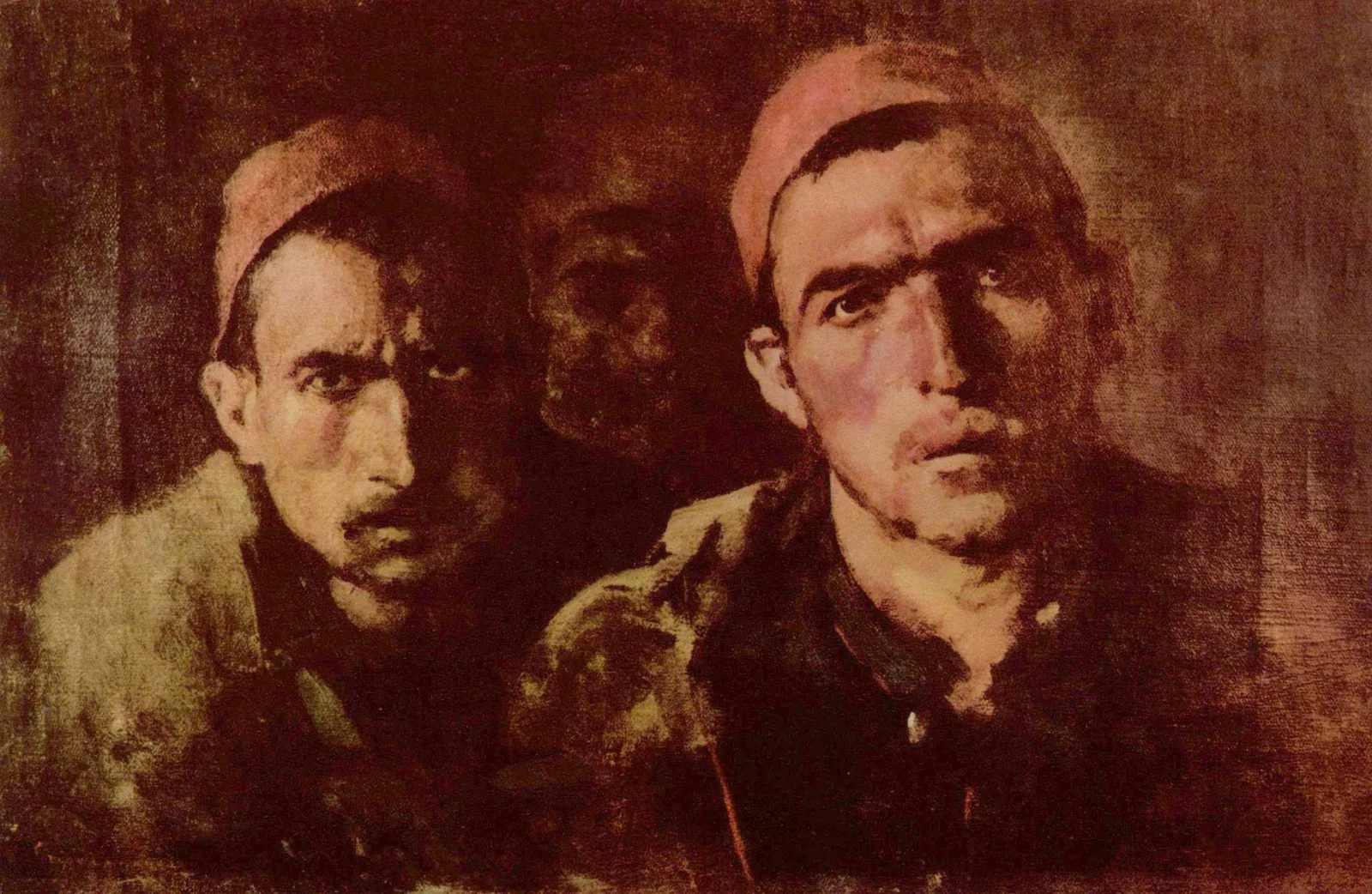 Nicolae Grigorescu, Prizonieri turci (Turkish Prisoners)
The paintings of shepherds and sheep caught my attention too, because I spend time with shepherds in my own work and it was nice to see that life on canvas. First among them is Arthur Garguromin Verona’s “Ciobani în pădure” (Shepherds in the Forest).
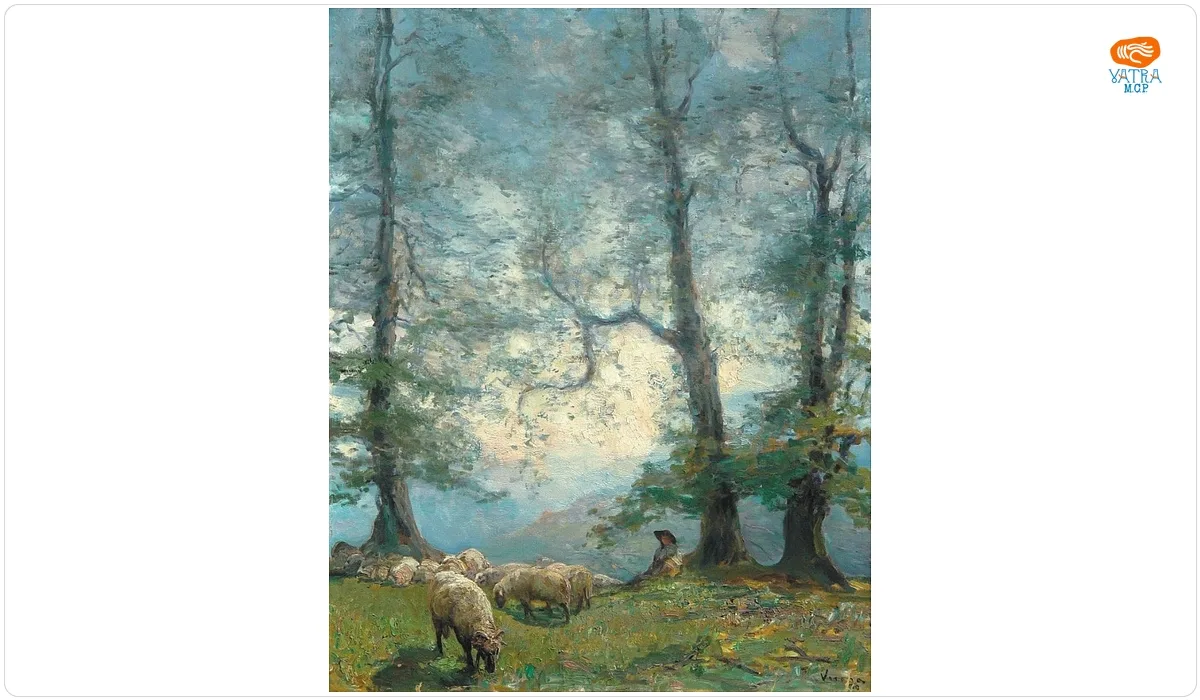 Arthur Garguromin Verona, Ciobani în pădure (Shepherds in the Forest)
Another is Sava Henția’s “Cioban bătrân” (Old Shepherd).
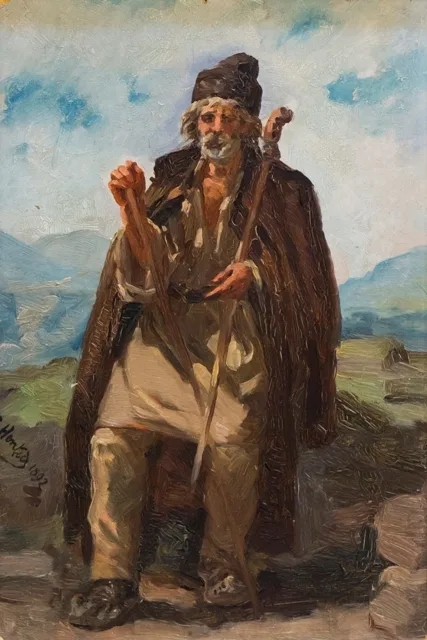 Sava Henția, Cioban bătrân (Old Shepherd)
By contrast, the National Museum of Transylvanian History (30 RON) and the Ethnographic Museum (15 RON) were much more rewarding. The history museum’s narrative was a bit weak, but the ethnographic exhibits gave us a real connection to the past; the similarities in traditional tools and textiles were a wonderful chance to compare with our own culture. Dinner at Samsara Foodhouse, however, didn’t live up to expectations. It was showy and badly overpriced, a reminder that fancy design, especially measured against what we found at Zama, doesn’t guarantee a good meal.
Thursday 23 April — Campus, Church and Hajongard
On Thursday we plotted a more natural route across the university campus. I wanted to show my wife the aquarium I had visited with the host team on Monday. The Zoological Museum and aquarium had a quiet, unpretentious beauty, and the lack of crowds made them feel like a hidden gem. Entry is 10 RON, free for students, but when we arrived there was nobody around to sell us a ticket; since students get in free, there isn’t always someone at the door. A student we asked for help simply told us to walk in. The ticketing was clearly set up for school groups rather than independent visitors, which gave the visit a very local feel. On the way off campus we made a short stop at Ursus Brewery (Kozel Mix and a flat white). Later, near St. Michael’s Church, we browsed the book stalls and picked up three English books.
In the late afternoon we went to the Hajongard Cemetery. It isn’t as magnificent as the famous cemeteries of Milan, but it has a raw, gothic atmosphere. We even came across two black marble tombs, each with a real dead crow lying on top. Coincidence?
We closed the day with drinks at Klausen Pubhouse.
24–25 April — Pharmacy Museum and Departure
By Friday we were completely exhausted. We started the day with breakfast at Eggscetera, which is exactly what it sounds like, a modern breakfast spot that puts eggs in everything. I ordered the Turkish eggs, known back home as çılbır. Then came our last cultural stop, the Pharmacy Museum (30 RON): a beautiful historic building, well worth the visit. We dropped the rest of the day’s sightseeing to focus on packing. We spent our last hours buying Romanian chocolate and a selection of local spirits: Discovery vodka, Zarea and the usual Alexandrion (a 70 cl bottle of the orange one accidentally made it into the box). After a short rest and the chore of squeezing everything back into our suitcases, we took a Bolt to the airport at 07:30 on Saturday 25 April; our plane took off at 09:55.
What we took home from Cluj was less the cobblestones that fought our suitcase wheels than the people we met on them. The image I remember most clearly is the driver in Turda, leaning on his horn to stop a bus we were about to miss.
Practical Notes
- Dates: Sunday 19 April 2026 – Saturday 25 April.
- Exchange rate: 1 EUR = 5 RON = 50 TRY.
- Airport to city centre (~9 km): Bolt/Uber ~40 RON (10–15 min) or trolleybus line 5/8 ~3 RON (25–35 min).
- To Salina Turda (~35 km south): Fany or Cento bus ~14 RON (45–55 min); for the last stretch, bus 17 from Turda centre or a taxi. Don’t take the train. Uber/Bolt one-way ~150–200 RON, but finding a Bolt/Uber back from Turda is practically impossible; take the bus or a taxi.